


Students and staff at Jerusalem’s Mayanot Institute of Jewish Studies had an extra reason to celebrate last week’s anniversary of a landmark federal ruling preserving communal ownership of a collection of rare manuscripts amassed by Chabad-Lubavitch leaders.
Rabbi Shais Taub, a U.S.-based expert on Chasidic thought and translator of the Kehot Publication Society’s newest addition to its Chasidic Heritage Series of seminal texts, gave students in Mayanot’s women’s program advance copies of the book in honor of the day. Entitled Feminine Faith, the book is an annotated translation of L’havin Inyan Shel Rosh Chodesh, a discourse delivered by the Fourth Lubavitcher Rebbe more than a century ago and recognized as groundbreaking for its discussion of feminine and masculine character traits, and its portrayal of the unique strengths of the feminine soul.
Taub also took the occasion to lecture on the structure, contents and importance of the work.
“The class was amazing,” said Hindy S., echoing the responses of other students. “He really connected to the psychology behind the discourse. It evolved into an intense discussion on the ways that women can cultivate others and influence their communities.”
The discourse, which was presented to the Mayanot students as a gift from Kehot, begins with a discussion about the special relationship between women and the monthly holiday of Rosh Chodesh, which Jewish tradition identifies as a reward for women’s refusal to participate in the worship of the Golden Calf.
From that launching point, Taub explained for the students how the discourse develops the idea of recognizing Divine Providence and the particular talent that women have for nurturing that recognition in others.
The night before Taub’s Dec. 22 presentation in Jerusalem’s Katamon neighborhood, he was lecturing across town for students in Mayanot’s men’s division. Also timed to coincide with celebrations of the library ruling’s anniversary on the fifth day of the Hebrew month of Teves, the class featured an in-depth examination of the Tanya, the foundational work of Chasidic thought penned by the First Chabad Rebbe in the late 18th century. Taub based his presentation on the Tanya Map, an atlas-of-sorts published by Kehot that is designed to orient students to the text and help them relate to its core messages.
“The Tanya is, in written form, a chance to ask personal questions,” remarked Taub, who composed the map. “It is meant to relate to daily life, to be something we live in.”
Throughout the week, special classes and book sales marking the anniversary took place throughout Israel and at locations around the world. Taub spent Shabbat in the Jerusalem foothills town of Bet Shemesh, where he presided over Chasidic gatherings and led a class for English-speaking residents. On Sunday night, he lectured on Feminine Faith at the Machon Alte women’s seminary in Safed, and was scheduled to lead classes Monday and Tuesday at Ascent, a Chabad-run youth hostel and study center in the city.
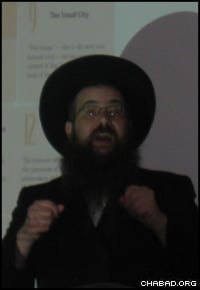
For his part, Taub emphasized that the library ruling was a pivotal moment in modern Chasidic history. The 1987 ruling determined that a Rebbe’s life is completely dedicated and belongs to the Jewish community at large, and thus the books of his library do not belong to any one individual, but to the community as a whole. Following the case, the Rebbe, Rabbi Menachem M. Schneerson, of righteous memory, instructed that the day be commemorated with the publication of works of Chasidic thought and the acquisition of holy books by Jewish people everywhere.
“The whole point of the day is that Chasidic thought should be more widely disseminated,” said Taub. “The real victory is that the books should be printed and widely distributed, so that as many people as possible should learn them.
“So when the opportunity came to speak at Mayanot and elsewhere,” he continued, “I knew this would be the perfect way to celebrate.”
Rivka Marga Gestetner, director of the Mayanot women’s program, said that she was very pleased with the response.
“A number of women are, I think, continuing their study of the text on their own,” she stated. “This was a great introduction, and the women here are very excited about continuing.”





Join the Discussion